
Week One – Day Four
The Stress Cycle: What Stress Is & What It Does To You
Stress! Let’s talk about it. Whenever we encounter a perceived threat our fight-or-flight response kicks in to protect ourselves. Unfortunately, the way the fight-or-flight response does this – by literally readying the body to physically fight or to flee – is more suited to zebras running from a lion, or an animal protecting its offspring from a predator, than for researchers dealing with a difficult supervisor or a tight deadline. Unfortunately, getting physical or running away really fast isn’t going to solve the problem.
When the stress reaction kicks in, the sympathetic part of the nervous system, which deals with survival, is activated and causes the level of stress hormones including adrenalin and cortisol to surge. As a result, your heart races, your blood pressure rises, and you have more immediate energy. (This is why you are more productive just before that deadline!) The stress reaction causes the body to focus on survival rather than repair and growth. It suppresses the digestive system, the reproductive system and growth processes, as well as changes the responses of the immune system. In short: functions that aren’t required for immediate survival are repressed in favour of those that are critical. Once the threat has passed the parasympathetic part of the nervous system, which governs growth and repair processes, takes over and the level of stress hormones drops back to normal. This is also called the ‘relaxation response’. The body relaxes and recharges.
The problem with the fight-or-flight reaction is three-fold.
Firstly, it can be triggered by anything that we perceive to be a threat. A stressful thought we attach significance to can cause a full-fledged fight-or-flight reaction.
Secondly, the fight-or-flight reaction is a reflex, an instinctual reaction, while the relaxation response is not. If perceived stressful situations abound the fight-or-flight reaction can be turned on continuously, overriding relaxation, renewal and growth processes. There isn’t a single of our body and mind’s functions that isn’t affected by this in the long run. Chronic activation of the fight-or-flight response can cause anything from headaches, to insomnia, to depression, to fatigue, to anxiety, to weight gain, to trouble focusing and functioning in general. In the extreme case it can lead to severe disruption of your nervous and hormonal system. For academics, the bad news is that chronic stress destroys brain cells and impairs memory and learning (more on this in week 2).
Thirdly, if the fight-or-flight response is constantly triggered, the mind and body become accustomed to higher levels of stress hormones. It becomes your your new ‘normal’. That’s why people often don’t recognise they are about to burn out. Feeling stressed has become their normal baseline condition.
The stress reaction can be pictured as a cycle:
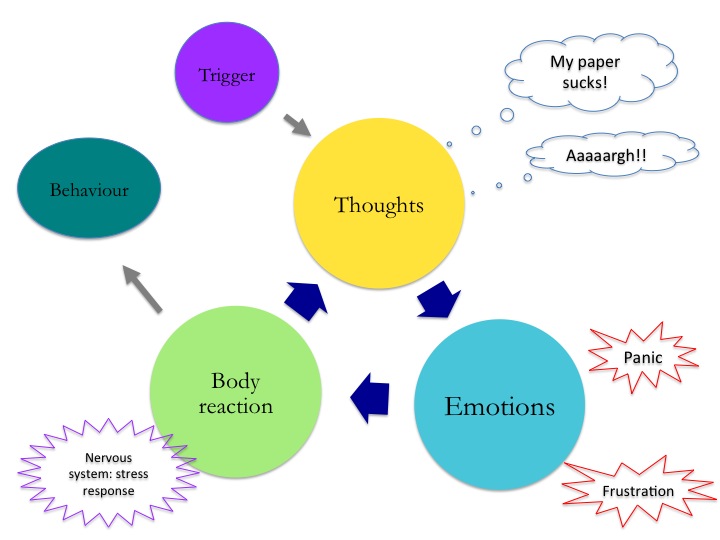
The stress cycle starts off with a trigger. Let’s say you wake up one morning and realise you have an important deadline in a couple of days time. Your paper isn’t ready, however. So, that’s the trigger for stressful thoughts, such as ‘my paper sucks’, ‘I’ll never get it finished on time’, ‘OMG’ and ‘Aaargh’. When we get to the ‘Aaargh’ phase stressful thoughts lead to stressful emotions such as fear, panic and frustration. Then, the body kicks in with a stress reaction. The stress reaction in itself leads to uncomfortable sensations, leading the brain to think it’s an emergency situation, which then leads to stressful emotions etc. etc. perpetuating the cycle. The stress response also influences our behaviour. Our system believes it is in an emergency situation, and takes action accordingly. Unfortunately, this doesn’t necessarily lead to effective action. Coping behaviours may include isolating ourselves, getting angry with family or lovers, smoking, eating, drinking, whatever your drug of choice!
As you will understand, these phases occur more or less simultaneously in our minds and bodies. It does help, however, to distinguish between them, as they provide different aspects of the stress reaction. The stress cycle can be broken at any particular point of the cycle. Exercise breaks the stress cycle at the physiological level, while meditation will help calm both the body and mind, and works on all of the links between trigger, thoughts, emotions, bodily reactions and behaviour. With meditation, the key is awareness. You will become practiced in the art of noticing that you have slipped into a habitual stress pattern, and can then decide to do things differently.
The majority of academics I know (yes, the majority!) have had to take time off from work at some time in their career due to stress, or have only just managed to hang on at some point. This topic isn’t much talked about: people tend to keep these things quiet. Just know that if you are feeling stressed and overwhelmed you are definitely not alone. It is a wise investment of your time to develop self-care structures that can prevent the worst of this, and will help you bounce back if you do hit a rough patch.
Assignment
Map your Stress Cycle Pick one of the stressors you identified yesterday, and ask yourself:
- What are my thoughts when I am stressed by this issue?
- How do I feel when I am stressed by this issue?
- How does my body feel when I am stressed by this issue?
- What is my behaviour when I am stressed by this issue?
Take the time to explore these different aspects of your personal stress reaction.