
Week Five – Workshop: Supervision Meetings
Supervision: A Meeting of the Minds
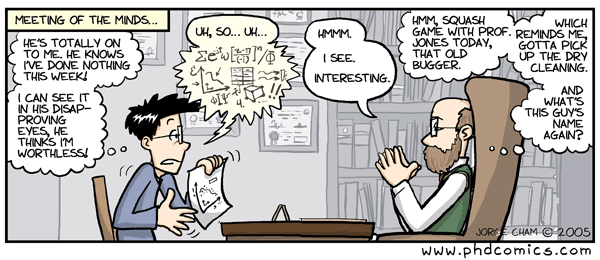
Supervision meetings are opportunities for a meeting of the minds. Or, maybe not. Maybe, they are primarily opportunities to self-obsess, and project your insecure thoughts onto whatever your supervisor said. I have to admit that I was guilty of doing this. As I confessed yesterday, my main fear when I was in the middle of writing my PhD was that my work wasn’t good enough. Supervision meetings were, I am embarrassed to say, often all about that question: ‘Does he think it’s good enough?’ And my supervisor needed to really convince me he thought it was good enough. If there was any room for doubt, I knew that what he actually meant was that it wasn’t. Maybe he just didn’t want to hurt my feelings and say it out loud.
I remember a meeting with my supervisor in which he had said my latest chapter was ‘fine’. So of course, I thought: ‘I’m not sure about that. Maybe, because he is Irish, he is being indirect, and it’s not that great. Maybe he doesn’t like it. Yeah, he probably doesn’t like it at all. What a disaster.’ Half an hour later I bumped into my other supervisor, and I couldn’t help but ask her: ‘He told me my chapter is fine. But what does he really think of it?’ She told me that if he had said it’s fine, it’s probably fine. Oh my lord. The problems we create for ourselves! Now, in my defence, my supervisor was of the evasive sort. I played the part of the insecure PhD student pretty well, but he played the part of the absent-minded professor brilliantly. Put together, we were a real team.
Step 1
The cure for projection is two-fold. Similar to yesterday, this tool is inspired by Byron Katie’s ‘The Work’. She is phenomenal.
First, listen to what has been said, and take it at face value. If he said it’s fine, it’s probably fine! Write down what was said, and what you think it means. It may even make you laugh. If it doesn’t make you laugh, ask yourself the question: What you think it means: ‘Is it 100% unfalsifiably true?’ Probably not…
|
What was said: |
What you think it means: |
|
‘It’s fine’ |
It’s probably not good enough |
Step 2
The second step is to write down what you think the other person is thinking (sounds complicated, but don’t we do this all he time?). So, I think my supervisor is thinking: ‘her work isn’t good enough’. The third step is to take the other person out of the equation. Replace ‘he’ or ‘her’, with ‘I’; replace ‘her’ or ‘his’ with ‘my’. Be a little creative here. Just try to get as many ‘I’s’, ‘me’s’ and ‘my’s’ into the statement as possible. So, doing this – the statement becomes: ‘My work isn’t good enough. I am pathetic.’
|
What I think my supervisor thinks of me |
What I think of myself |
|
Her work isn’t good enough. It’s pathetic. |
My work isn’t good enough. I am pathetic. |
You can now see the elephant in the room. You have found out what you are likely thinking about yourself, but have projected onto the other. If it’s a difficult issue for you, make sure to go back to what was originally said, and verify that your thoughts and your fear have nothing to do with reality. Nothing. Whenever my supervisor says my work is fine, I see proof that my work is not good enough, and that I am pathetic. Right. Maybe let’s not do that anymore.
Step 3
Replacing ‘he’ or ‘her’, with ‘I’ also works wonders to dismantle judgment. It’s an additional step you can add to yesterday’s tool that can give you a whole new perspective on what you’re grappling with. Find out whether you may be more frustrated with yourself, than with your supervisor.
Step one is to list all your judgments of the other person (what this incident tells you about him/ her as we have seen yesterday).
Step two is to replace the words ‘he’ or ‘her’, with ‘I’; and replace ‘her’ or ‘his’ with ‘my’.
Step three is to find examples of how the new, reversed, statement may be true. I’ll give you some examples based on yesterday’s story.
|
What this incident tells you about your supervisor |
What this incident tells me about myself |
|
No matter how hard I work, it’s never good enough for him. He never even notices the amount of work I’ve done. He never listens to me. He doesn’t understand me. He doesn’t give a &^%# about me or my work. How dare he use his position to restrict me and put pressure on me?! He is a cruel $%%$#^&^ |
No matter how hard I work, it’s never good enough for me. I never even notice the amount of work I’ve done. I never listen to me. I don’t understand me. I don’t give a &^%# about myself or my work. How dare I use my position to restrict me and put pressure on me?! I am a cruel $%%$#^&^ |
Let’s see what we can make of these thoughts:
MM: 'No matter how hard I work, it's never good enough for him' becomes 'No matter how hard I work, it's never good enough for me.' So, 'No matter how hard I work, it's never good enough for me.' Could that be true?
A: Ouch. It is true. Oh man!!!
MM: Can you find some examples of how this is true?
A: Yes, I can.
1. When my supervisor says my work is fine, I don't believe him. It's not good enough for me. His reaction isn't good enough for me, and my work isn't good enough for me.
2. Whenever I hand in a chapter I feel I haven't done enough. It's not good enough for me.
3. At the end of practically every workday I have the feeling I haven't done enough. It's not good enough for me.
Wow. I am hard on myself! Forget about my supervisor, trying to live up to my own expectations is a nightmare!
With some judgments this tool works better than with others. Even if you get some not so obvious new statements, play around with them anyway. You may find some truth in them. An example:
MM: 'I am a cruel $@$#^&^.' Could that be true?
A: What do you mean I am a cruel $@@$#^&^?? Obviously not!
MM: Can you find examples of how this is true?
A: Seriously?
MM: Seriously. Give me examples.
A: OK. I am a cruel $@$#^&^ for being so hard on myself always.
MM: Yes, that for starters. You are a cruel $@$#^&^ for yourself. What about others. Are you ever cruel to others?
A: OMG, yes I am a cruel $@$#^&^! I am a cruel $@$#^&^ for always thinking the worst of my supervisor! He says my work is fine, he allows me to go to Chicago, it's always good enough for him, and I think he is the bad guy!! This is so funny! I am a cruel $@$#^&^! I am cruel to him and to myself.
When you apply these tools make sure that you are gentle with yourself and don’t blame yourself for anything. I found out I am a cruel $@$#^&^, but it’s hilarious, not serious. If your reaction is a despondent one: ‘I am a cruel $@$#^&^. Oh, now this is proof I really suck,’ that’s not the aim here… This tool is not about beating yourself up. It’s also not about proving that you are to blame for every problem you have. You aren’t the bad guy. But very often, nor is your supervisor! The purpose of the tool is to stop believing your uncensored thoughts and judgements, so you can create some space and freedom in your mind.
If you find out that the flipped around statement has truth to it, it also doesn’t mean that any grudges or grievance you have are unfounded. I may have been quite right that my supervisor didn’t pay attention to me or my work, that he didn’t coach or mentor me well, and that he could have done a much better job at acknowledging my efforts. All of this is true.
But the reason it got to me so badly was because his behaviour triggered my own insecurity and perfectionism. His reaction to my Chicago request and his not-completely-over-the-moon reaction upon reading my chapter which he said was ‘fine’, became entangled with my own fears and insecurities. I fully believed and was fully invested in: ‘My work isn’t good enough’ and ‘It’s never good enough for him’. Keep an eye out for similar statements that are variations on that devil of a thought: ‘I am not good enough’. They are pervasive and wreak a lot of havoc.
Once you find out that feeling insecure (or whatever it is for you, but feeling insecure in the PhD process is a big one for many people) is the core reason for your emotional reaction, your supervisor becomes easier to deal with. By separating your own insecurity from whatever he did or did not do, you will stand a far better chance of discussing any issues you may have with your supervisor.
In my case it would have meant I could simply discuss with him what ‘good enough’ meant:
- In the Chicago situation we could have agreed on specific targets.
- In the general supervision situation, I could have discussed with my supervisor that I was not always sure whether the quality of my work met the standards of a defendable PhD/ the standards of a publishable paper. This would have been an invitation to coach me in this process of: ‘yes it’s good enough’, or ‘it’s nearly good enough’, or: ‘no, it needs more work.’
I could have handled those answers. With my feeling insecure out of the way, I may have even been able to discuss his ‘incentives’ and ‘encouragement’ to always work harder, and that this way of approaching me left me feeling discouraged. But perhaps I would no longer have even been bothered by it….
Assignment
A Meeting of the Minds
If you find yourself annoyed with your supervisor – try this. It may turn out not to be that bad after all…
Dealing with Projection:
- Listen to what is being said. Write it down verbatim. What do you think it means? Compare these statements, and if there is a discrepancy between the two, stick with what was actually said! If necessary, ask yourself whether what you think it means is 100% unfalsifiably true. Probably not.
- Write down what you think the other person is thinking.
- Then take the other person out of the equation. Replace ‘he’ or ‘her’, with ‘I’; replace ‘her’ or ‘his’ with ‘my’. Be a little creative here. Just try to get as many ‘I’s’, ‘me’s’ and ‘my’s’ into the statement as possible.
- Reflect and see what rings true.
Dealing with Projection and Judgment:
- List all your judgments of the other person (what this incident tells you about him/ her as we have seen yesterday).
- Replace the words ‘he’ or ‘her’, with ‘I’; and replace ‘her’ or ‘his’ with ‘my’.
- Find examples of how the new, reversed, statement may be true.